Thursday, July 5, 2012

Jeju Island : Seongsan Ilchulbong (God's Masterpiece)

Seongsan Ilchulbong, also known as Sunrise Peak is one of the hottest attraction of Jeju Island.
Jeju Island (Island of Gods) herself is a volcanic island created naturally through volcanic eruptions almost 2 million years ago. Seongsan Ilchulbong is known as a volcanic turf cone, naturally created by a hydrovolcanic eruptions upon a shallow seabed approximately 5000 years ago. In another words, Seongsan Ilchulbong literally rose from the seabed as a result of natural volcanic eruptions under the sea.
This magnificent natural creation stands 180 meters tall with a crater measuring 600 meters in diameter and 90 meters high. The crater resembles a giant punch bowl. However, there is no crater lake here as the volcanic rock is too porous to retain any water. Reported to have 99 sharp rocks surrounding the crater, Seongsan Ilchulbong resembles a giant crown.
Seongsan Ilchulbong is located at the most eastern tip of Jeju Island and hence is a perfect place to watch sunrise, hence she is also known as the Sunrise Peak. The park has a time table for the entire year of when the sun will rise each day so that visitors can timed their visits. However, if one wants to watch sunrise from Seongsan Illchulbong, one would have to stay overnight at Seongsanri, in order to rise early and make the 20 to 40 minutes climb, depending on your fitness, to the summit.
The climb up can look daunting. When we were at the foot of the hill, we were wondering whether we could actually reach the summit because it definitely looks like a long climb. Word of caution here. If you are visiting Seongsan Ilchulbong, make sure that you do not come in your evening wear and high heels! Apparently there are over 500 steps to climb and walk to reach the steep hillside before you commence you climb to the summit. Honestly, I did not bother to count because I was more concerned of making sure that I reach there.

The beauty of the walk and climb is that, each step that you take makes you want to take the next one and before long, as you look down and over the cliff, a magnificent scene will greet your eyes and take your breath away. Suddenly, you feel all alive (still puffing and grasping for air mind you),  and marvel at one of GOD's masterpieces. 

Truly, He is the Master Sculptor but then again, if HE can CREATE the entire universe, what is a small volcanic turf cone......
The view of Seongsanri village below from the half way mark up to the summit...Truly breathtaking...
A natural rock formation that resembles the head of bear along the climb to the summit ...
Finally ....we MADE IT....at the summit of Seongsan Illchulbong at 180m ....
Now, this is a scene that you don't see everyday and definitely not your normal postcard picture of Seongsan. Caught this little boy helping nature by contributing a bit of nutrition to the beautiful purple flowers that are aplenty at the foot of the hill.....

Tuesday, July 3, 2012

Jeju Island : Seopjikoji (Romance is in the air)

Now that I am done with my post on my latest travel to Beijing, I will get back to write about my trip to South Korea 2 years ago. Yupe. This is a backdated post but I guessed I better write it down and share of this wonderful country and the places that I have the privilege to set foot on and experience them first hand.

I have blogged about Seoul in some of my previous posts. From Seoul, we took a flight for a 4 days 3 nights stay at the romantic and beautiful Jeju Island down south. If you are visiting Korea, Jeju Island is a definite MUST SEE and MUST VISIT location, especially if you are visiting in Spring. (We went in Autumn. So I guessed I would have an excuse to go back again .....:))

We managed to arrange for a private English speaking tour guide cum driver and he was simply magnificent. In fact, he made our stay in Jeju Island even more enjoyable through his jokes and detail explanation of the places we visited.

I will start off with our visit to this picturesque location at the eastern tip of Jeju Island, known as Seopjikoji (Bump in the Land).
The moment you set eyes on Seopjikoji, you will be greeted with a vast open meadowy green (spring) or brownish, yellowish (autumn) field, fronting an open ocean. There is literally not a single tree from the jagged rocky shore line. Only vast open spaces. With the strong ocean breeze blowing into your face as you, holding the hand of your loved one, take a slow climb up the long winding stairs to the lighthouse and chapel, you will feel a deep sense of liberation and romance. Romance is certainly in the air!
Beyond the clift as you looked down, you will see jagged and interested rock formations, stretching out to the clear blue ocean with waves splashing ever so majestically against the shore line. At the end of the long climb stands a lone lighthouse, standing like a sentinel, gravely watching and warning the ships that passes by below. From the lighthouse, you will get an awesome bird eyes view of the entire coast and shore line of Seopjikoji. And then, there is one single unique solitary rock jutting out called the Seondol Rock. 
Because of the beauty of this location, many korean movies have been shot here. One famous one of course was the Korean drama, "All In" starring heartthrob Lee Byun-hun and raising star Song Hye-gyo filmed in 2003 which include a chapel, convent and daycare center. The small white chapel was featured in the movie where Song went to become a nun after finding out that her friends have been implicated in the murder of a local mobster. The entire set was destroyed by Typhoon Maemi and was eventually reconstructed, now with a small casino. Now, I am not a Korean drama fan and the only movie I managed to finish was Dae Jang Geum (Jewel in the Palace).
The skies were rather gloomy when I was there in autumn and hence I could not capture this picturesque location with clear blue skies and equally interesting clouds formation. Otherwise, this would have been one perfect set for landscape photography. Nevertheless, I was still happy with the outcome of the pictures of this breathtaking site and like I said earlier, I will definitely revisit hopefully in Spring and breath in the romance that is in the air ......

Monday, July 2, 2012

Beijing China : Mutianyu, Great Wall (A deserving Wonder of the World)

How can I visit Beijing and NOT go to the Great Wall of China. After all, she is one of the seven wonders of the world, something that I have been taught since my primary school days. Even as a child, I have also marveled at the Chinese military strength and my early exposure to the stories of the Three Kingdoms simply made me dreaming of a visit someday...someday.....

And finally here I was....in Beijing and an opportunity to visit the Great Wall....
On the day of our departure and since our flight was at 1am in the morning, we had time. We made arrangements with this driver highly recommended by a good friend and we booked him to take us out to visit the Great Wall. Since it was a Saturday following a public holiday on Friday in China, he recommended us to visit Mutianyu, a less crowded section of the wall which is located about 70km away from Beijing.

Although supposedly less crowded, there were still plenty of tourists and buses. There is a cable car ride from the foothill to the levels of the wall costing RMB80 (RM40) for a return trip. This is highly recommended for the less adventurous as hiking up from the foothill to the wall is still some distance away and there is still plenty of walking and climbing to be done on the walls herself.
The cable car ride with a section of the wall in the background....

I was simply thrilled the moment I stood on the walls looking up at the ridges and down on the valleys below. Suddenly I became a child, reliving all my childhood memories and of the drawings I had made of Chinese warriors fighting on horse backs and arrows raining from the wall on the enemies below. Suddenly, the memory of grandmother going through my drawings and encouraging me comes flooding back....

Mutianyu is one of the most interesting sections of the Great Wall. Unlike the more popular Badaling and the Juyongguan, Mutianyu is not only less crowded but has also some of the features not found on other sections.
Mutianyu stretches a total of approximately 2.5 kms over the mountain ridges with sharp drop of cliffs on both sides, covered with pine forests. The wall is approximately 7 to 8 meters tall and is approximately 4 to 5 meters wide. This section of the wall was reconstructed by General Xu Da of the Ming Dynasty (16th Century) on remnants of a wall originally built by the Qi Dynasty (550-577).

This is the section of the wall with probably the most watch towers. A total of 22 watch towers were built along this 2.5 km stretch, approximately one watch tower every 100 meters. The Mutianyu section connects the Juyongguan Pass on the west to Gubeikou on the east, and remains as one of the largest construction scale and best quality sections of the wall, built to protect the marauding nomads from the north against the capital and the imperial tombs.
Built using granite, this section of the wall is also unique because both the outer and inner parapets are crenelated with merlons (small openings on the wall of the fort) so that arrows can be shot from both sides of the wall on enemies, a feature apparently rarely found on the Great Wall.

Because this section is less crowded, there are certain sections of the wall where you could find yourself alone with her for a short instance and that moment is simply magical. 
As you stand over the wall, looking over the ridges from one of the many watch tower to another watch tower and as your eyes scanned over the horizon, over the forests below, just for a brief moment, one could almost sense the importance and urgency of a tower guard looking out for any invasion from the north. You can also imagine the scene when soldiers fully armed and ready to do battle were rushed to the wall, as the alarm was raised .....their eyes peeled on the enemies' movement below with their bow bend, ready to sent that one arrow into the hearts of their targeted enemies...defending their homeland, their families and their Emperor from the barbaric tribes who will show no mercy if they breached the wall .....
...and suddenly you are snapped back to the present by the clicking sounds of cameras and loud chatters of eager tourists, cramping to get that perfect picture of them and one of the seven wonders of the world.....

...and that my dear friends, is the Great Wall of China. You might see it a thousands times on National Geographic, postcards and movies but nothing, nothing beats being there yourself because no picture, no movie and no video could capture and translate the essence of her greatness and her beauty .....See you there soon...... 

Friday, June 29, 2012

Beijing China: Temple of Heaven (The need of man to connect with Gods)

I am going to postpone my postings on Korea for a short while and write about my recent visit to Beijing last week. As I have mentioned in my earlier post, I would be relocating there soon and you should be expecting to see more posts (hopefully) on the beauty of Beijing and China for the next two years.

Although I was there for a week, we were busy going school and apartment hunting. I had to opportunity to squeeze out a day for sight seeing and I was contemplating where I should head to first. Yes. Beijing has that much to offer and even deciding which place to go can be perplexing. I opted for the Temple of Heaven as some other places are rather far off. Anyway, I have the entire two years here to explore them in depth.

I was staying at the Westin Beijing located in the city center. I took a cab from the hotel and braving the morning traffic where the major roads were still jammed pack, even at around 10:30am, the journey still took a good 40 minutes that cost me RMB40 (RM20).

Temple of Heaven, å¤©å£‡, is located at the southeast of Beijing. The entire ground covers 2.73 square kilometers and is huge, comprising of a series of religious buildings built between 1406 and 1420 under the reign of Emperor Yongle of the Ming Dynasty who also oversaw the construction of the Forbidden City when he moves his capital from Nanjing to Beijing.
Originally known as the Temple of Heaven and Earth, Emperor Jiajin during his reign renamed this as the Temple of Heaven and built three more temples, Temple of Sun on the east, Temple of Earth on the north and Temple of Moon on the west. In the 18th century, Emperor Qianlong of the Qing Dynasty carried out further extension and renovation to the existing structures.

I have seen the pictures of this place for hundreds of times before and have never really comprehend the massiveness of these structures, the ground it covers or her significance to the ancient Chinese empires....until I stood on her grounds....

The first sight that greeted was the Circular Mount Altar, Huanqiutan, the place where the ancient Emperors are to make offerings to the Gods of Heaven during winter solstice and to pray for a good harvest as well as worship of his ancestors.
Can you imagine the might Emperor Qianlong walking up these stairs during his heydays, in all solemnity and grandeur, offering prayers to the Heavens....?

Once passed the Circular Mount Altar, I am faced with the Imperial Vault of Heaven, a small round building housing the tablet of God of Heaven and the tablets of the emperor's ancestors. This structure is almost similar to the larger Hall of Prayer for Good Harvest, except that the Imperial Vault of Heaven is only single tier while the much larger Hall of Prayer consists of three tiers. The Imperial Vault of Heaven, built by Emperor Jiajing in 1530 and further renovated in 1752, was surrounded by a semi circular wall known as the Echo Wall, Huiyinbi. Legend has it that you can hear a whisper from one end of the wall to the other based on the ancient Chinese advance knowledge of sound waves. However, do not even hope to try to test this out, as the wall is perpetually crowded with tourist shouting at the top of their voice.
The beautiful woodcraft and intrigue designs of the Imperial Vault of Heaven. Simply amazing ....

The entire temple grounds are surrounded by beautiful green gardens consisting of hundreds if not thousands of mostly cypress trees, reputed to be hundreds of years old. The oldest apparently is close to 600 years old!

Linking the Imperial Vault of Heaven to the Hall of Prayer for Good Harvest, is the long Red Stairway Bridge, Dianbiqiao. This bridge is 30 meters wide and 360 meters long, slowly inclining upwards, as if one is now slowly strolling up to the heavens....
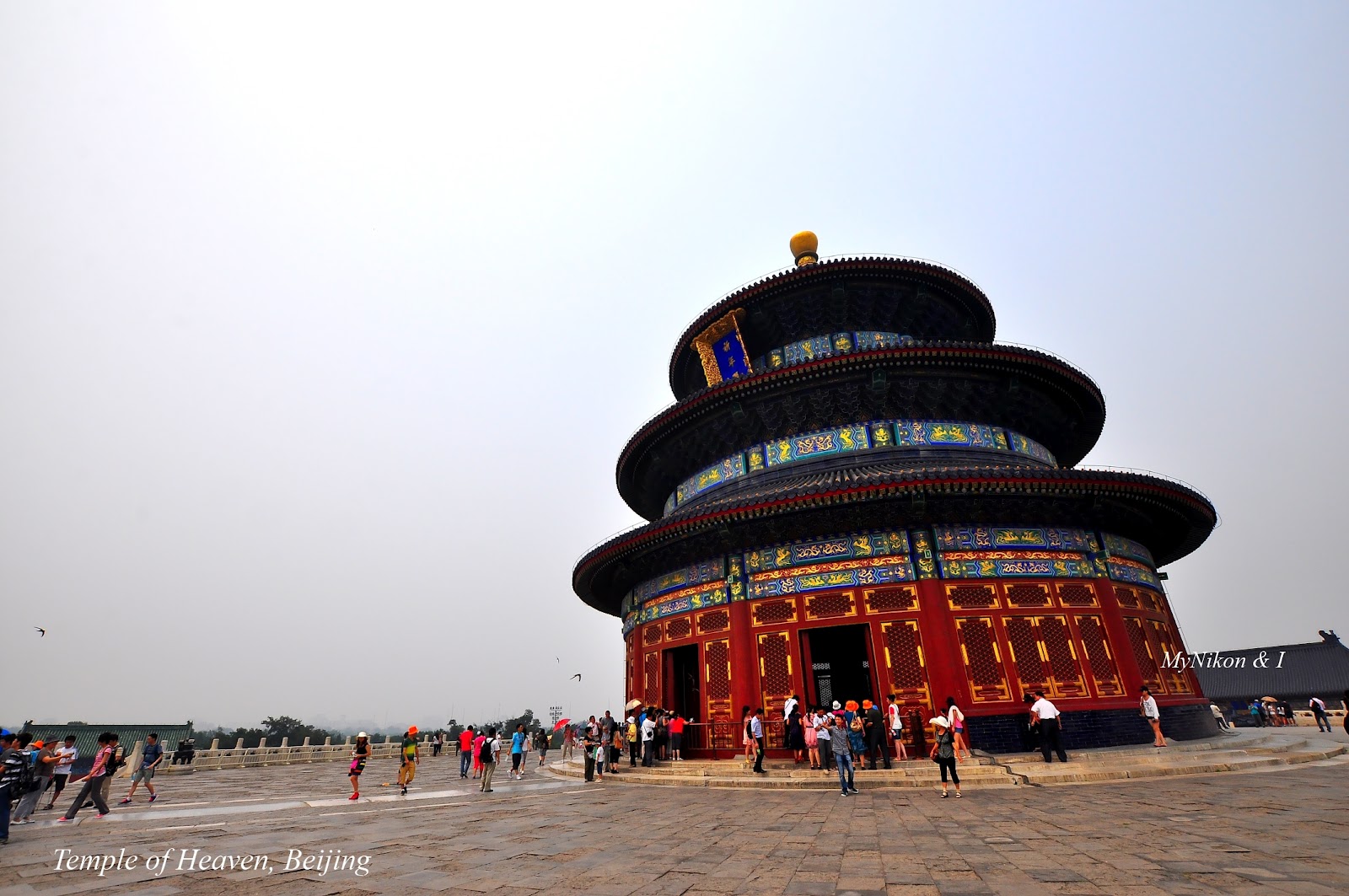
And after this long and impressive pathway and you will finally see this magnificent structure, The Hall of the Prayer for Good Harvest.

The Hall of Prayer for Good Harvests, Qiniandian, is located at the north of the Red Stairway Bridge and is the last huge structure in this temple grounds. This structure is a architecture wonder, 3 tier circular structure, supported solely by 28 pillars with absolutely no beams or nails in her construction. Why 28 pillars? The main four pillars in the center of the temple is known as the Dragon Well Pillars, 12 more to represent the 12 months in a year and 12 more to signify the 12 time periods of which a day is divided into. Each pillar is made out of a single tree trunk and the main four pillars (Dragon Well Pillars) is well over 19 meters tall! Considering that this structure was built in 1420, this is truly an amazing feat and a clear testimony of the ancient Chinese grasp of technologies we still marvel at today.
The vast temple ground ...I took this picture from one corner at the back of the temple ground where there were lesser crowd...Sitting there, if you could close your eyes and try to imagine the grandeur and the fanfare it must have been during the Ming or the Qing Dynasty when the Emperor, also known as the Son of Heaven, offer his prayers and worship to the Heavens and his ancestors, asking for blessings and a bountiful harvest for the people, knowing fully well that any countrywide famine or natural disasters would spell serious trouble to his reign and government, as he would have been perceived as being punished or abandoned by the Heavens and his offerings,  not accepted and his ancestors have not been appeased. 

With that in mind, it then began to make sense to the amount of thoughts, state funds, efforts, blood and sweat put in to put up these structures. Every circle and every square, every number, every column, pillar, bridge, walkway, pathway, steps and trees were there for a particular reason and omen, each according to the Chinese feng shui and believes, each meant to bring forth blessings, peace and prosperity. Herein, lies the underlying age old fact that no matter how powerful one is on earth, one can not but believe, accept and fear even, the ONE who is above.
If you look carefully into the design of the steps leading to the Hall of Prayer for Good Harvest, you will notice that it starts with designs of waves (water/sea), followed by tall mountains which stretches to the heavens denoted by the formation of clouds. I particularly like this picture because among the clouds, I have captured in the reflection of the sun.

Leaving the Temple of Heaven via the East Gate, I walked through a long corridor also called the Seventy Two Corridor which passes by the Imperial Kitchen. This corridor takes you past the vast cypress trees garden, truly a feast to the eyes. I was however stunned by what I saw as I walked past a particular section of this corridor. On both sides of the corridor were packed with locals, both young and old, men and women ...gambling!
I understand that this is the most common and favorite past time activities of the locals. I have even witnessed locals with their vans, cars or lorries parked by the roadside and the occupants happily having a game of cards sitting by the roadside. It saddens me when I see this supposedly sacred structure being `abused' in such a manner.

There is still much to see at the Temple of Heavens, such as the Rose Garden and the Hall of Abstinence which I have not yet visited. But I will be in Beijing for awhile and I will definitely make it a point to revisit this magnificent structure in other seasons, now that I have seen it in summer. Till then, stay tune for the next post on one of the seven wonders of the world, The Great Wall of China.....

Wednesday, June 27, 2012

Korea : Daepohang Port (Fishy Fishy)

Sorry for the recent absence folks. Just got back from Beijing for a one week scouting trip. We would be relocating there in October 2012 and the last one week was spent getting to know Beijing a little (since we have never been to Beijing before) besides checking out schools and apartments. I still managed to visit the Temple of Heaven and the Great Wall at Mutianyu despite our busy schedule. Will get to that in my next post before I forget.

But for now, back to Korea.

On our trip to see Seoraksan (my last post), we were brought to the little town by the seaside, known as Daepohang, located at Sokcho. Daepohang Port as this place is commonly called, is a small little fishing town and is a MUST visit destination for those travelling up to Seoraksan.

Here, you will find yourselves walking along a narrow street, one side lined by vendors akin a wet market back in Malaysia, selling fresh seafood of almost every size, shape and colour and the other side lined with seafood restaurants, ever so tempting.

A walk in the wet market and you will discover that it is bustling with activities of both locals and tourist alike choosing and bargaining over the wide variety of fresh, and when I said fresh, I really meant LIFE seafood, swimming in the pots and containers of multiple colors.

Taking a slow stroll along this place allows you to witness a little about the lifestyle of the locals who have been plying their trade here for decades. It was also simply amazing to see so many species of FRESH seafood which either I have not seen before or have only seen them frozen from supermarkets.
Those were Fresh salmon roe...something I don't get to see at all back home..Simply superb...

The only regret I have was I was not able to spent some time here to savor these fresh tempting seafood that looked so succulent and delicious simply because our tour has our lunch menu planned elsewhere as we rush to Seoraksan. Given another opportunity, I would definitely want to come back and sit by the wooden benches, having my raw sashimi, downing Korean shochu and enjoying the view of those graceful seagulls gliding just above the calm blue waters .....Care to join me?

Wednesday, June 13, 2012

Korea: Seoraksan (Mystical mountains)

Korea is not all about tall sky scrappers and shopping. Once you travel out of Seoul, there are plenty of magnificent mother nature and God's creation to see and admire.

Over 70% of peninsular Korea is mountainous and hence, there are several spectacular mountain ranges that will definitely capture your imagination when you are there. One such mountain and probably one of the most visited mountain is Mount Seorak, also known as Seoraksan.
Apparently, this is the one place that every Korean will want to visit at least once in their lifetime and I can understand why when I stood there, looking at the peaks and the valleys. Somehow, there is a mystical sense about these mountains. As you stand silently among the rocks and the pine trees and listen, it is almost as if you can hear God Himself. It is simply amazing. Words just can not describe the smallness of our fragile human form, dwarfed by the towering and magnificent mountain peaks or the sheer depth of the plunging valleys.

I joined a tour I booked through the hotel from one of their tour brochures. It was cool, almost like a personal tour with just another couple from Singapore, with our guide and our driver. The journey from Seoul to Seoraksan took almost 4 hours and we made a couple of stop along the way. I went to Korea during autumn and I was totally excited and expecting to see the hue of red, yellow, orange and green maple leaves which I saw just a little in Seoul. I heard that Seoraksan is beautiful in autumn and I was looking forward to it.

We started off from Seoul at around 7:30 am. and on the way, we stopped by this look out point for my first glimpse of Seoraksan ....a view of Ulsan Bawii...
Legend has it that the rock, Ulsanbawi was walking to the north to represent the city from Ulsan, southeast of Korea when Mount Kumgang (Kumgangsan) was being built. However, he arrived too late and there was no room. Ashamed, Ulsanbawi trudges back home and when night fell, came to rest at Seorak. When he woke up, he found the place so beautiful that he decided to stay there forever.

Autumn was indeed beautiful here at Seoraksan. The trees were all decked with leaves of green, yellow, orange and red. Such a feast to the eye and for one like me, who have never experienced autumn, this was paradise to me....
Since this is a popular tourist destination, be prepared for a long wait for the cable car ride to the top of the mountain. We waited a good 2 hours. While waiting, we took a walk at the foot of the hill that still gives you a spectacular view of the mountains and temples.
The cable car will take you up to a certain point of the mountain and there is still a significant part to track to the highest point. It is definitely advisable that you do not come wearing your best dress or gown and leave your high heels back in the hotel. The view at the top is simply breathtaking.
A look at one of the many peaks at Seoraksan ....
This is one of the many small temples found scattered throughout Seoraksan where monks used to meditate ..This one is apparently 120 years old !
Climbing to the top take a significant amount of effort but the efforts are well worth it...You will be rewarded with this magnificent and breathtaking view from the top. 

There is another beautiful mountain range found on Jeju Island but I will leave that to another post ....stay tuned ....