Wednesday, September 11, 2013

Love and Betrayal at Shanhaiguan


The Great Wall, built over a period of 2,000 thousand years and  by different rulers and dynasties, resulting in death of between 1 to 3 million people (as said in some internet articles) stretches a total length of 8,852 km from the Lop Nur in the west to the east ending 20 meters into the Bohai Sea at Shanhaiguan. It is difficult to really know the full length of the actual wall over the years but there were even estimates that it could well exceed 21,196km, taking into consideration of all the different sections that are no longer in existence. The current wall as we know it, is largely constructed during the Ming Dynasty.

 
I am particularly interested in the eastern section of the wall at Shanhaiguan (山海关). Firstly, this is apparently where the wall begins as she snakes westward and secondly, the wall was built extending approximately 20 meters into the Bohai Sea.

Fortunately, Shanhaiguan at the city of Qinhuangdao, Hebei Province is located approximately 3.5 hours drive from Beijing. So, when the opportunity came up for us to take a weekend trip, we jumped at it. We were forewarned by our driver, guide cum friend that this is a major tourist attraction among the locals and to expect a crowd. The place was certainly crowded but I find it far more comfortable and pleasant as compared to places like the Pingyao ancient town in Shanxi.


Shanhaiguan, literally meaning “The Pass of Mountain and Sea” is where the first pass is located known as the “FIRST PASS UNDER HEAVEN” (天下第一关). I have always been intrigued by the Great Wall and living in China now has given me the opportunity to visit her more often. The experience I had at Jingshanling and Mutianyu has got me hooked. Hence, standing there where she starts her journey westward and ending 8,852 km in Lop Nur over numerous ridges and valleys and the very first pass of the many multiple passes was a special experience to me


However, the current day Shanhaiguan is mostly a reconstructed section since she has been destroyed and plundered so many times over the centuries, speaking to a large extend the strategic location and how important she is.

As I do more research on Shanhaiguan, it appears that Shanhaiguan is more than just the first pass of the Great Wall. This is where, the love for a lady and a betrayal led to the end of the Ming Dynasty and the start of the Manchu rule in China (Qing Dynasty) for the next 300 years, effectively ending the very objective of which the wall was created 2000 years ago, which is to stop the marauding Manchu armies from the north.

This is also where the legend of a lady who wailed and cried for her husband who died constructing the wall, till a section of the wall crumbled, apparently touched by her sorrow.

Wu Sangui (吳三桂) is the general in charge of Shanhaiguan, keeping the Manchu armies at bay despite numerous attempts. Around this time, rebel forces under the leadership of Li Zicheng has taken over Beijing, ending the rule of the Ming Dynasty with the suicide of Emperor Chongzhen who hanged himself on a tree (the tree still visible) at the Jingshan Hill in Beijing. General Wu was about to seek alliance with the newly appointed new emperor but news that his beloved concubine, Chen Yuan Yuan (陈圆圆) has been taken custody by the new emperor, angered him so much that he turned to the Manchu’s leader, Dorgon. His betrayal by opening the pass at Shanhaiguan, resulted in the Manchu sweeping into China and swiftly took over the land, established the Qing Dynasty that ruled China for the next 300 years!

Another love story that surrounds Shanhaiguan is how the lovely Meng JianNu (孟姜女), whose newly married husband Fan Qiliang was forcefully taken to construct the wall. When winter came, with no news from her husband, Lady Meng went to the wall with new winter clothes only to find out that her husband has died during the construction and was buried within the walls. Legend has it that she cried in sorrow and the wall was so touched by her sorrow that it came crumbling down, giving up the remains of her husband. A temple has been constructed in memory of her love and dedication.

The part where the wall meets the sea is known as Laolongdou (老龙头) or the Old Dragon’s Head. This is where the Great Wall starts and she is called the Dragon’s Head and the rest of the wall, her body stretching all the way westward.
 This is where the wall ends in the Bohai Sea.
This is the part of the wall that stretches from Bohai Sea inland towards the mountains, westward through China, finally ending 8,800 km at Lop Nur.
The wall at "First Pass under Heaven" stretching towards Jiao Shan (
角山), the first mountain she climbs in her journey westward.

This is another attraction that not many foreigners would go due to the distance from Beijing and I am glad that I have the opportunity to be here, up close and personal.

Tuesday, September 10, 2013

Beidaihe Wetlands


A visit to Beidaihe was definitely not on the cards when we set off last weekend. Our actual destination was the Shanhaiguan Pass, located at Qinhuangdou, the north eastern coastal shore of Beijing at Hebei Province.

Shanhaiguan Pass literally meaning “Mountain and Sea Pass” is the first pass for the Great Wall of China on the eastern front, where the Wall ends 20 meters into the sea. (More of that in the next post).

We stumbled upon Beidaihe on our way looking for a place to stay after visiting Shanhaiguan. Most of the hotels at Qinhuangdao were really expensive and there is only one international chain hotel, namely the Holiday Inn and a simple deluxe twin bed room was quoted at RMB950, which is even more expensive than that located in Beijing.

Calls made by our driver cum tour guide cum friend, found the newly opened 5 star Sheraton Hotel and apartments (by the same developer) at Beidaihe. We took a three room apartment which was just opened 2 months ago for only RMB768 (RM380).

Beidaihe, is a coastal summer resort located approximately 3 hours drive from Beijing. This is apparently where most of the locals, especially government officials and the well-to-do Chinese go for their summer and beach vacation to relax. There were plenty of local hotels and the town was brightly lighted up with bulbs of every colour possible. Judging from the Russian words that were put up everywhere as well as a fair amount of Russian tourists also suggest that this is a rather popular tourist destination for the Russians.

The beach which is the main reason for most that were there is not exactly what we expect. Having seen better beaches back home in Malaysia, not to mention the exotic ones located at Bintan Island or Maldives, we find the beaches rather dirty, rough yellow sand with murky waters. Resigned to the fact that there is nothing much to see, we had our breakfast and decided to drive around town for one last time, before we go back to our hotel, packing our bags heading back to Beijing.
 And then, there she was, the vast wetlands of Beidaihe, stretching out to the Bohai Sea. And there were group of photographers along the stretch with their tripods and umbrellas focussing on something out there. I had to stop to see. I told our driver to drop me there and come back to pick me up later. I hurriedly got down, got my gear and made my way towards the sight of the wetlands. As I got closer, I realised the subjects that got the attention of all these photographers….BIRDS of various species.
These are bird watchers and nature photographers and most seemed rather serious in their passion if not professionals. Expensive cameras mounted on sturdy and huge tripods and lens longer than my arm and thicker than my thigh, lens and cameras that I can only dream about.
The longest range camera I had was only my Nikkor 18-105mm kit lens and I have to make do, since bird photography has never been my forte or my interest. I was there for the scenery and my Sigma 11-20mm f3.5 wide angle and my kit lens would be just perfect for those.
Beidaihe is supposed to have nice and clear skies with a mild climate all year round. Unfortunately, that was certainly not the case when I was there. The skies were overcast and gloomy, blanketed by a thick layer of smog that covered the clear blue skies and made everything in the distance blurry.

As a photographer for landscape, this could not have been a worst case scenario. I don’t mind overcast and gloomy skies with dramatic rain clouds brewing but a dull grey sky has really nothing much to offer.

Looking at the wetland, I can only imagine how much more mesmerizing and amazing she would have been if only I catch her on a bright sunny day, with blue skies and cloud formation clearly reflected on the still waters, intermittently disturbed by flocks of white cranes and birds that I don’t even recognise, landing, basking and picking up small fishes (I presumed) and taking off in beautiful formation.

But there are still plenty to focus on despite the setbacks.
I found out later that Beidaihe is THE PLACE in CHINA and also one of the four havens for bird watchers in the world because of variety and numbers of migratory birds that come by here at different times of the year. Honestly, I have never seen large flocks of wild white cranes anywhere else, so free and uninhibited.

Dachaoping where I happened to chance upon is reputed to be the best spot in Beidaihe and rightly so, judging from the beauty of the landscape and the sheer number of birds there. 
It is easy to get totally lost in the vast piece of breathtaking landscape and sometimes forget, what some other professional photographers termed as `supporting cast’. I closed my eyes for a moment and when I reopened them, I saw other parts of this beautiful place, like the two below, a small patch of tiny white flowers `screaming’ as they were, wanting recognition among the long orange and red weeds  ……

and the lines of very green shady trees next to the wetlands.


This is not exactly a place where most foreign visitors visiting Beijing would end up due to her location and neither would I recommend you to come all the way here just for the wetlands, especially if you are not a bird enthusiast and you have very few days to spent in Beijing. But I am glad that I have stumbled upon a gem and an opportunity to have pictures to remember her by.

Monday, September 9, 2013

Hangzhou Flying Mountain

A mountain that flew all the way from India to China? Hard to believe?

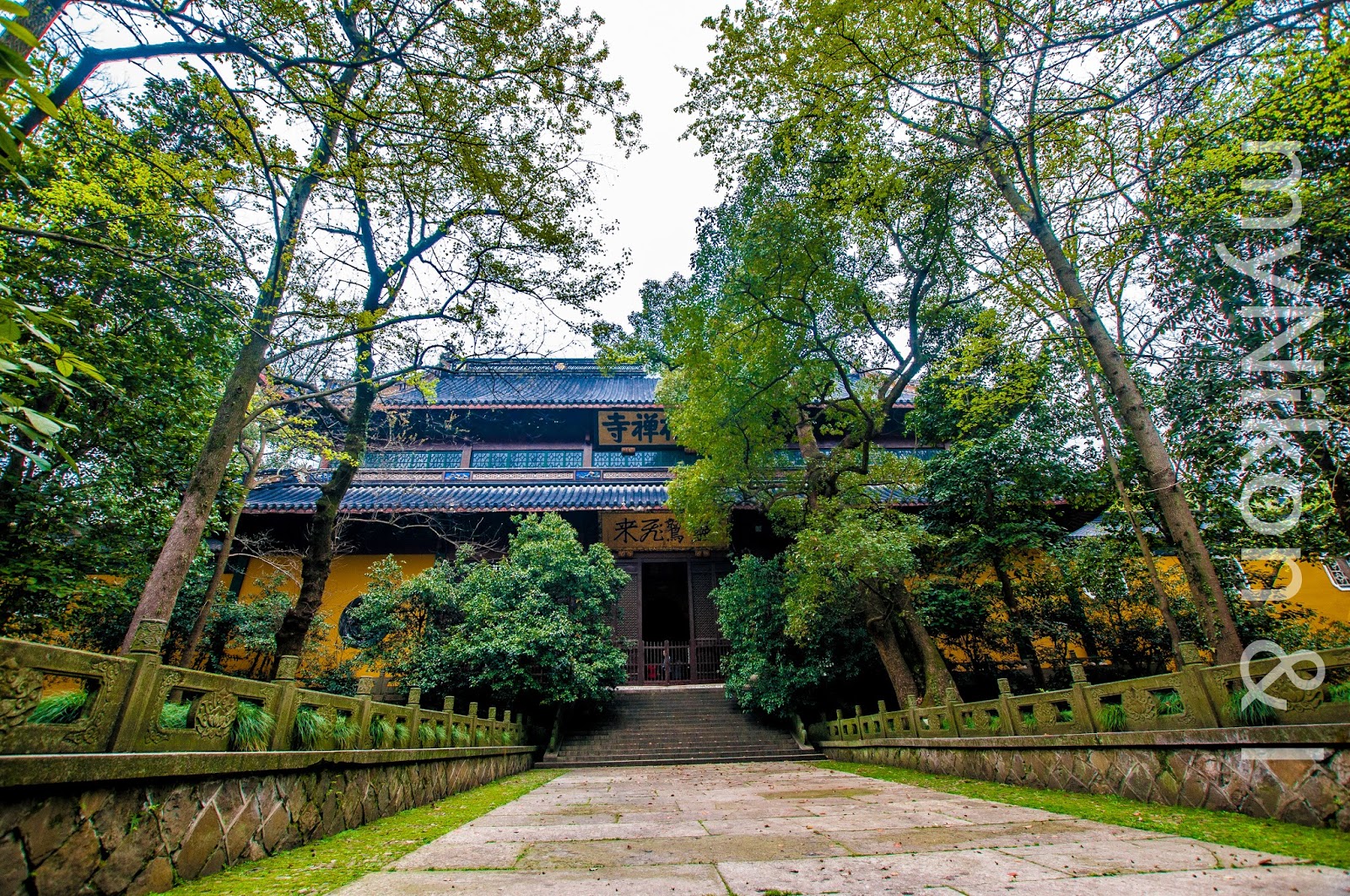
So says the legend. Feilai Feng (飞来峰) located at the Lingyin Temple (灵隐寺) in Hangzhou, near to the West Lake is a huge limestone mountain measuring 209 meters (700 feet) tall. Legend has it that she flew all the way from India and ended up here in Hangzhou. This rock formation is definitely unique considering that this is the only limestone rock formation among the common sandstone mountains in that area. 


It was said that an ancient monk by the name of Hui Lin, who had just came back from India saw this rock formation 1600 years ago and was convinced that this rock, similar to what he had saw in India had flew all the way and made her home in Hangzhou, as a demonstration of the great omnipotence of the Buddhist law.  

You will find a total of 345 scruptures both big and small carved out on the face of this rock, some dating as far back as 951AD. There is also another legend that surrounds the existence of so many Buddha statues carved on the rock. It was sad that before the rock finally landed on her current location, she has been flying all over the land, crushing and destroying anything in her path. The statues were carved to suppress her to her current position. 

 
Among the many interesting carvings found here, one that immediately stands out is the carving of the Laughing Buddha sitting on the cliff by a stream with his belly exposed. It was said that his rather `big’ belly is where he kept all the world’s worries. 

In one of the core caves within this rock formation, there is huge carving of bodhisattva Guanyin. There is a crack on the wall of the caves that reaches all the way to the ceiling and it is said that if one stands at the exact place, you could see a tiny light shining through like a thread all the way up. Hence this cave is known as “One Thread of Heaven.” (一线天)


Located just outside the Feilai Feng is a huge pagoda said to contain the remains of Hui Lin, the great monk who discovered Feilai Feng.


Feilai Feng is located within the temple grounds of Lingyin. The crowd at Feilai Feng can be taunting especially on weekends or public holidays but as one wanders through the temple grounds, which is currently one of the largest and wealthiest Buddish monesteries in China, the crowd thins and you begin to feel a deep sense of peace, the type that is not only external but spiritual to a certain extend, one that touches your soul. 


For whatever reasons, your soul quiets down and your worldly worries tend to slip away as you climb up the steps to reach the top of the monestary. (I get goosebumps even as I write this article, just recalling the calmness I felt even though the visit was more than 6 months ago). 


Maybe it has to do with the name of the place to begin with. Lingyin Temple is also known as the Temple of the Soul’s Retreat and rightly so, because that would be exact innner peace and tranquility that one’s soul tend to feel as your eyes feast on her many calm, serene yet mesmerizing sights. 

I am not a Buddist yet I left this place, feeling refreshed somewhat and a sense of peace that I have not enjoyed for a long while. 
 

Maybe, just maybe, my soul has been truly refreshed from this small but short retreat that I encountered at Lingyin.

No amount of words can properly described that feel. You just got to be there to experience it.

Wednesday, September 4, 2013

The Charm of West Lake


Mentioned Hangzhou and you will be thinking and talking about WEST LAKE (西湖). The beauty and charm of WEST LAKE is legendary. Hence, it is hardly surprising that we made it a point to visit Hangzhou during our last trip to Shanghai.

Hangzhou is approximately 2 hours drive away from Shanghai. We left Shanghai early in the morning before the early morning office rush hour and the drive from Shanghai to Hangzhou was pleasant. But little did I expect to take another hour to reach West Lake after we arrived at Hangzhou. The traffic congestion getting into West Lake was horrific and it was quite a turn off for me. The place was so crowded and almost every corner you turned, there are people, tourists, tour buses and cars.

If you are thinking that you would experience any form of serenity that a lake so beautiful and charming would offer, you would be seriously disappointed. Everything here was a rush. Even a stroll around the lake would not end up a stroll, as you have to constantly dodged tourists cycling past, or being pushed or bumped into or avoid bumping into some groups of local tourists who would without warning just stopped dead in their tracks to take pictures. It was far from what I would expect.

 
The gloomy skies and slight drizzle when we arrived was not helping either and any attempt to take pictures turned out rather disappointing and dull.

Having said that, I must admit that the West Lake is indeed a charming and romantic place, if one discounts the noise and the crowd. The vast lake surrounded by mountains on three sides in the background and islands with pagodas in between, is definitely a wonderful sight to behold. I can only imagine how much more mesmerizing she can be, on a clear sunny day where the lake is blue with clear reflections of skies and trees or on a bright moon lit night.


The beauty of the West Lake has become the blueprint and influence of so many other similar lake gardens around the world. West Lake was made a UNESCO World Heritage site in 2011. The West Lake scenic area covers approximately 60 square kilometers and the lake itself covers 5.6 square kilometers. The average depth of the lake is reported to be only 7.4 feet.

Taking a ride in one of the row boats offered is definitely one of the best ways to appreciate the lake and most of her scenic sites if you have limited time. However, the cost of such a ride is pricey, considering that this is one of the most visited places in China.


One day is definitely not enough to truly appreciate the real beauty of West Lake. Unfortunately, we did not have the time needed. Given an opportunity, I would like to revisit this place, stayed at a hotel within walking distance to the lake and stay back late into the night when the crowd is long gone, to sit by her shores under the moonlight, watching the reflections of the moon and the lights from the LeiFeng Pagoda. Maybe then, I would truly experience the romance and the true charm and beauty that the old scholars had shared in their songs and poets.

Tuesday, September 3, 2013

Shanghai Bund New and Old


If and when you are visiting Shanghai, I am pretty sure the name of this one place would be definitely comes up top. Nobody and no tour agency would give this place a miss and that place is the famous BUND!


I had to make two separate trips to the Bund when I was in Shanghai. The first night I was there, we went too late and all the glittering lights that made the Bund what she is was already switched off around 9:30 p.m. There were literally nothing to see, only dark buildings and even darker side opposite the Huangpu River where the Oriental Pearl TV Tower and the sky scrappers were.

Hence, on the day that we returned from Hangzhou, we made it a point to visit the Bund immediately before even going back to the hotel, to grab a cruise down the Huangpu River and savor the beauty and charm of this magnificent landscape at night, basking in all her glittering lights.

Also known as Zhongshan Dong Li Lu (East Zhongshan First Road), she has been an iconic street in Shanghai for hundred of years. Stretching approximately 1500 meters, there are 26 buildings of different and unique design and architecture that defines the Bund. This stretch fronting the Huangpu River, looking across the Pudong Financial District was once the most romantic corner in Shanghai. It still would be if NOT for the hundreds if not thousands of tourists there every night, talking or shouting on top of the voice and having their pictures taken.


Taking a river cruise down the Huangpu River is a rather interesting experience. As you cruise down this very important river in Shanghai, you would clearly see the difference between the west and the east side of the river. On the west side is the Bund, with her 26 signature buildings of different design, architectural, bearing resemblance from different eras such as Gothic, Baroque, Romanesque, Classicism and the Renaissance, a time of the glorious past. If you close you eyes, and if your imagination allows you, you can even bring yourself, traveling back in time to the golden era of Shanghai yesteryear and imagine how romantic that scene would be.


On the east side, however, is the complete opposite. Instead of old colonial style buildings, are the tall sky scrappers with colourful neon lights and advertisements displays, constantly changing hue and colour. Here lie the three tallest buildings in Shanghai and among the tallest in China and the world. The first to catch your attention will of course be the colourful and unique iconic Oriental Pearl TV Tower. Then, there is the Jin Mao Tower, an 88 floors tiered pagoda shape building which until recently was the 5th tallest building in the world. She is now of course dwarfed by the even taller building and currently the tallest building (soon to be surpassed), the Shanghai World Financial Centre, standing at 492 meters with 101 floors, making her the third tallest building in the world.


The landscape here is going to change even further with the soon to be completed Shanghai Tower with a height of 632 meters, taking over as the tallest building in Shanghai and China and the second in the world.

 
We were told an interesting story surrounding the constructions of the Shanghai World Financial Centre and the Shanghai Tower. I am uncertain as to how true the story was but it is still interesting nevertheless and holds true to the pride of the mighty Chinese.

Story has it that the Shanghai World Financial Centre was designed and built by the Japanese. The current square opening right at the top of the building, which made this building’s design unique, was initially a circle but the idea was strongly objected upon by the Chinese because it represents a symbol of the Japan’s rising sun. Hence, it was changed to her present state.

But having the tallest building built by the Japanese is not exactly something that the Chinese are proud of and some even said that the very sharp angles and edges of the building from far looks similar to a samurai sword. Hence, the Chinese then designed and commenced building an even taller structure next to her, namely the current Shanghai Tower, cylinder in design, looking more like a sword sheath to hold her `within’.

 
Regardless whether the story is true or otherwise, the Bund and the Pudong Financial District are still a must visit places when you do drop by Shanghai. In fact, if you have the time, I might even suggest that you see her once during the day and then again in all her splendour at night.

And if you are photographer, don’t forget to bring your tripod and you will be rewarded with shots that you would be happy to go home with.

Saturday, August 31, 2013

Zhujiajiao Ancient Water Town


When one visits Shanghai, several top tourist attractions are a must. A walk down the Bund, taking a river cruise down Huangpu River in the evening to enjoy the glittering Bund on one side and the Shanghai Financial district with a good view of the Pearl Tower on the other, not forgetting having a picture taken with the Pearl Tower and shopping at the famous Nanjing Street.

Not many itineraries would include a visit to this 1700 years old ancient water town located approximately an hour ride from Shanghai and reportedly one of the four best preserved ancient water town in Shanghai.
Zhujiajiao (朱家角) or simply known as the Zhu Family Settlement with a population of approximately 60,000 dates back all the way to the Yuan Dynasty. She is also known as the `Pearl Stream’ because this little town will glimmer at night among the landscapes of lakes, rivers and mountains.
When I did some research before my trip to Shanghai, I was not particularly impressed with all the common places that most tour agencies will take me and I was looking for something more Chinese. The pictures of Zhujiajiao caught my attention with her canals, rivers, sleepy willow trees and old ancient cottages. Hence, I gave specific instructions and made specific request that I wanted to visit Zhujiajiao and slot that into our itinerary somehow. Fortunately, our driver was accommodating enough and willingly slot in a full day visit to this place on the last day at Shanghai before we made our way to the airport.

On arrival, my first impression of this place was rather disappointing. It was a Sunday and just like any other tourist attractions in China, especially this particular one which are rather popular with local tourists, this place was absolutely packed to the brim. There were so many people pushing along the narrow streets and jostling to get their pictures taken. 
My first thoughts were to turn back and go home. But having travelled more than an hour from Shanghai, there is no turning back. Braving the crowd, we made our way carefully and rather `forcefully’ pushing back the crowd who constantly walk right into your face, which happens so often in China with the local tourist, to the nearest restaurant to have our lunch, to gather our composure, to take a breather, to get over the initial shock and to plan the next course of action.

The lunch break did help. We ordered some local dishes which turned up rather delicious though a little pricey (which is expected of a place this crowded and popular). With our stomach filled and I had my local beer, we were ready to do battle on the narrow streets and alleys, crowded with tourist and locals peddling their souvenirs.
Most of the cottages have been turned into either cafes, restaurants, tea houses, snack shops or souvenir shops, managed by the locals. I must say that this place is overly commercialised and very touristy. If we had not stay longer till the evening when most of the crowd left, I would not rank this place as a place that I would enjoy but enjoy I did as the day drew to a close.

One of the best way to avoid the crowd and to get an introduction of the place and some of orientation as to where to go for a walk would be to take a boat ride. They offered several routes with different prices. We took the cheapest which amounted to RMB30 per person covering 4 destinations, since there were 6 of us and the journey lasted approximately 20 minutes. It was short but was also the most enjoyable 20 minutes as our boat went into narrow canals, lined by sleepy willow trees with their leaves hanging over the water and ancient old cottages lining both side of the canal. I began to enjoy and appreciate the true beauty of this quaint ancient water town.

Towards the evening, as the sun sets and her rays dimmed, and as the lights of the many cottages came on and the crowd leaves, as the temperature cooled down, the smell of spring was refreshing.

This is the best moment to savour the true beauty and charm of this 1700 years old water town. Walking down the now almost deserted alleys, a sense of serenity and tranquillity descended upon place, which hours ago was bustling with hundreds if not thousands of people, squeezing among themselves through these same streets and alleys.

Soon, it was time for us to leave this place to catch our flight back to Beijing but I leave with a sense of satisfaction that Zhujiajiao has not disappointed me. Although this place, like some many other places in China, has been overly commercialised, I still had that opportunity, for a short moment in time, to experience and to see her in her natural serenity and charm.

Hence, a word of advice if you are planning a visit, it might make good sense to either stay longer and wait for the crowd to leave or simply visit her later in the day, to truly enjoy what Zhujiajiao has to offer.